The First Bill for Public Kindergarten
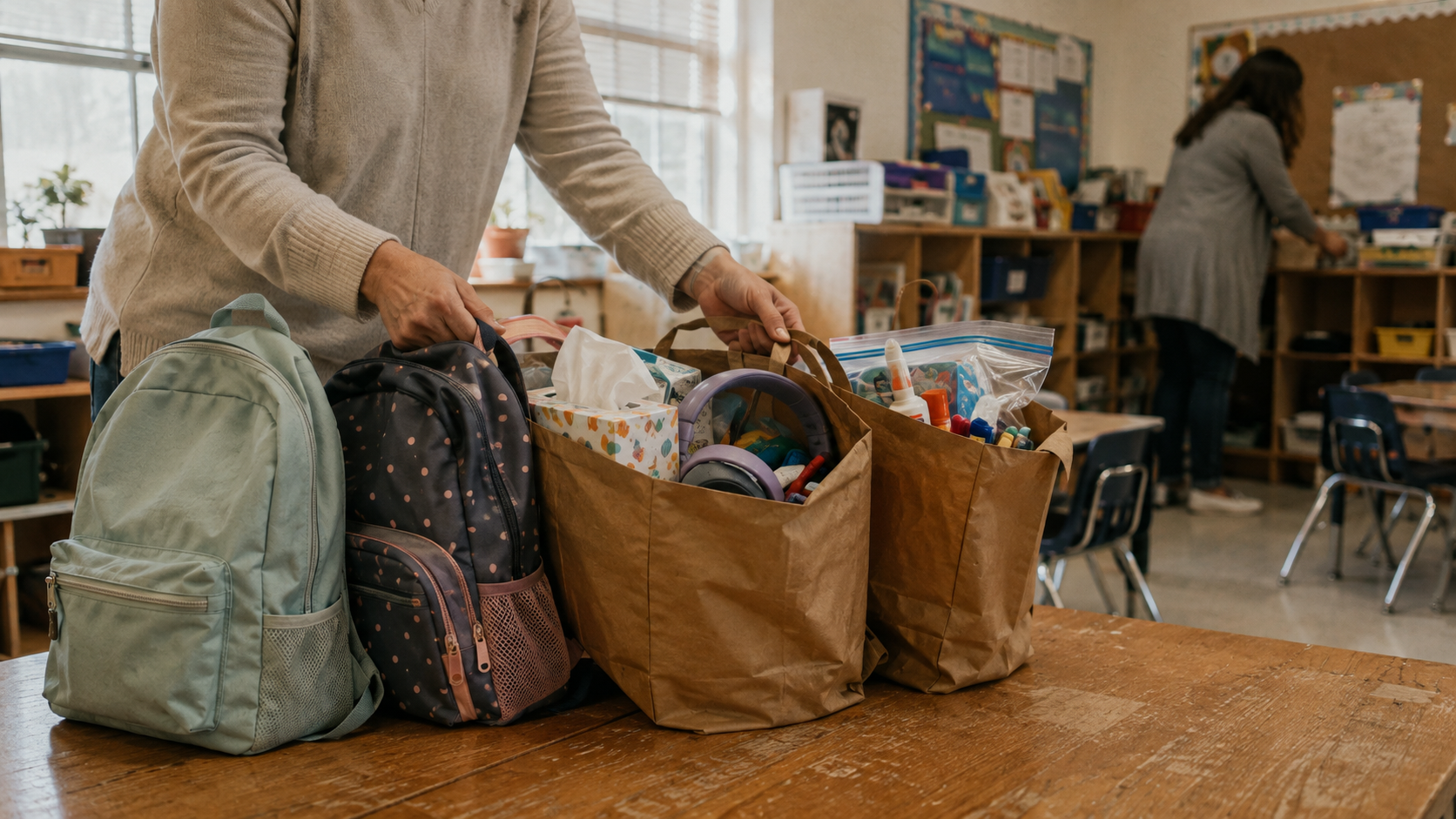
Before our twins could begin public kindergarten, we received the school supply list. Between them, they were expected to arrive with twenty-four Elmer’s glue sticks, four containers of Play-Doh, four boxes of crayons, four packs of markers, two boxes of tissues, two sets of wired headphones, and assorted other supplies. Our son was assigned two containers of Clorox wipes and a box of quart-size storage bags. Our daughter was assigned two containers of baby wipes and a box of gallon-size bags. The art teacher requested disinfecting wipes too.
I expected to buy crayons, backpacks, and perhaps a pair of scissors. I did not expect two five-year-olds to require the adhesive capacity of a small construction crew.
We are fortunate enough to afford the supplies without hardship. What bothered me was what the list revealed. Along with personal items for our children, our household was expected to help stock the school.
Perhaps kindergartners really do use twelve glue sticks apiece. I have spent enough time around five-year-olds to find that entirely plausible. Tissues disappear, markers dry out, and Play-Doh presumably suffers a high attrition rate. Their teachers understand what a kindergarten classroom requires far better than I do. If these materials are necessary, however, why are they not treated as part of the cost of operating the classroom?
Some supplies belong to the individual child. A backpack carries belongings between home and school, while headphones may be used by one student throughout the year. Clorox wipes and plastic storage bags are harder to understand as personal possessions. The list removes much of the ambiguity by dividing those items between boys and girls. Boys are asked to supply disinfecting wipes and quart-size bags, while girls supply baby wipes and gallon-size bags. These are contributions to a common inventory, not individual supplies. The list assigns each household part of the responsibility for stocking the classroom.
That responsibility extends beyond either of our children’s classrooms. They have different teachers but received the same kindergarten list, which is part of a school-wide document covering every grade and the art program. Obtaining supplies from families is a school-level practice, not a choice made by an individual teacher.
Which costs belong to the school?
Organizational boundaries are usually discussed in terms of who works for an organization or which activities it performs. But they also help determine which costs the organization treats as its own. A delivery company that expects drivers to use their personal vehicles still depends on cars, fuel, insurance, and maintenance. Those costs have not disappeared simply because the company does not pay them. They have been moved outside its budget and left for the drivers to bear.
The school supply list does something similar. The classroom needs these materials, the teacher organizes their use, and the school’s educational work depends on them. But because families purchase and deliver them, they do not appear as part of what the school spends to operate the classroom.
Even the label “school supplies” makes the expectation seem more reasonable. We are accustomed to thinking of school supplies as things families buy for their children. It might be a harder sell if the same items were described as “classroom operating expenses.”
There is also something odd about how the materials are purchased. Rather than buying consumable supplies in bulk and distributing them according to need, the school asks twenty or more households to purchase and deliver predetermined quantities. The school gets the materials, while the cost and purchasing work remain with families.
The safest place to put a shortfall
The school can safely leave these supplies to families because parents are exceptionally unlikely to let the classroom go without them. They want their children to begin kindergarten prepared, and few want their child to arrive without the requested materials. Refusing to buy the wipes would not register as a meaningful protest against Ohio’s approach to school funding. It would simply leave the teacher to find another way to obtain something the classroom needs.
Teachers face an even more direct version of the problem. If the tissues run out in February or an activity requires materials the school has not provided, the teacher can ask families again, change what she planned to do, try to obtain school funds, or pay for the supplies herself. None of this is new to me. My mother taught first grade, and she routinely spent her own money on classroom materials. Teachers have been filling these gaps for so long that doing so can seem like part of being a good teacher. When the alternative may diminish what students receive, buying supplies can feel like an extension of a teacher’s responsibility, even when it compensates for something the school did not provide.
Organizational researchers Stuart Bunderson and Jeffery Thompson describe this willingness to sacrifice as one of the risks of deeply meaningful work. In their study of zookeepers, people who saw their work as a calling found greater meaning in it, but they were also more likely to treat it as a moral duty and sacrifice pay, time, and comfort. Teachers are not zookeepers, and parents are not school employees. But the underlying point applies to both groups. People who care deeply about the work being done—and especially about the children affected—are more willing to absorb costs that others might reject.
Schools do not necessarily set out to exploit that commitment. The supply list may simply be a practical response developed over many years by educators working within constrained budgets. Even so, it places the shortfall with the adults least willing to let children experience its consequences.
When making the system work hides what is wrong with it
By the time school begins, there is usually no visible shortfall. Families have sent in the requested materials, while teachers stretch what they receive and replace what runs out. The classroom has what it needs, and instruction proceeds. There is something admirable in that resourcefulness, but it can make the underlying problem harder for the organization to recognize.
In their seminal 1963 book, A Behavioral Theory of the Firm, Richard Cyert and James March argued that organizations compare their performance with an aspiration level, or an understanding of what counts as acceptable. When performance falls below that level, the shortfall triggers what they called “problemistic search,” an effort to identify and correct the source of the problem. But such a search can happen only if the organization recognizes that a shortfall exists.
If parents did not send supplies and teachers did not replace what was missing, classrooms would eventually lack basic materials. The consequences would be visible, and administrators might face pressure to change the budget. Instead, parents and teachers prevent the shortage from affecting the classroom. From the school’s perspective, the current system continues to produce an acceptable result. The more effectively parents and teachers fill these gaps, the easier it becomes for the school system to leave them in place. Their commitment keeps classrooms functioning, but it also makes the full cost of doing so harder to see.
The same pattern appears in other organizations. Universities, for example, often rely on faculty and staff to handle tasks that officially belong to no one. The institution continues to function because people close to the work compensate for what its formal systems fail to provide.
A private solution to a public obligation
For our family, the expense is manageable. For another household, buying supplies for several children may compete with groceries, utility bills, shoes, or transportation. The list costs the same regardless of income, but the burden does not. Families that cannot purchase everything may ask the school for assistance, although doing so requires them to disclose their need. Others may quietly omit items and hope the communal supply is sufficient. Teachers and other families then cover the difference while trying to make sure no child is singled out.
The school has transferred more than the purchasing cost. It has also left teachers and parents to manage families’ unequal ability to pay, all within a system described as free public education. Of course, “free” has never meant that families bear no school-related expenses. Parents buy clothes, backpacks, lunches, and many other things their children need, and there will never be a perfectly objective boundary between a family expense and a school expense. Tissues, disinfecting wipes, and communal storage bags nevertheless raise a reasonable question about which resources are included when the state promises to provide a public education.
Ohio’s other educational commitments make that question harder to dismiss. According to the state’s 2025 scholarship report, Ohio spent approximately $283 million on Traditional EdChoice scholarships during the 2024–25 school year and another $493 million on EdChoice Expansion. Together, those two programs directed about $776 million toward private-school tuition. EdChoice Expansion alone served more than 100,000 students, and families at every income level can qualify for at least some assistance.
Our public school district also buses some resident children to nearby private schools, including religious schools. It does so because Ohio law requires districts to transport certain elementary students to the public, community, or nonpublic schools they attend, subject to limits involving distance and travel time. This is not simply a local spending decision; the district is fulfilling a responsibility established by the state. Ohio has decided that private-school tuition and transportation can fall within the public obligation, while some basic materials used inside a public kindergarten classroom remain the responsibility of individual families.
A dollar spent on a voucher would not necessarily have purchased glue sticks for my children’s classroom. Ohio has also increased its overall spending on primary and secondary education, so the supply list cannot establish a direct tradeoff. Budgets nevertheless reflect choices about which costs government will pay and which it will leave others to absorb.
Of course we bought the glue sticks
We bought the twenty-four glue sticks and everything else on the list. Of course we did. Refusing would not change Ohio’s educational priorities. It would only make two kindergarten classrooms harder to run.
That is why the system works. Parents and teachers care too much about the children affected to let a classroom go without what it needs. The classrooms open fully stocked, while only part of what it took to stock them appears in the school budget.