The AI-Restored University: Returning to the Faculty Core
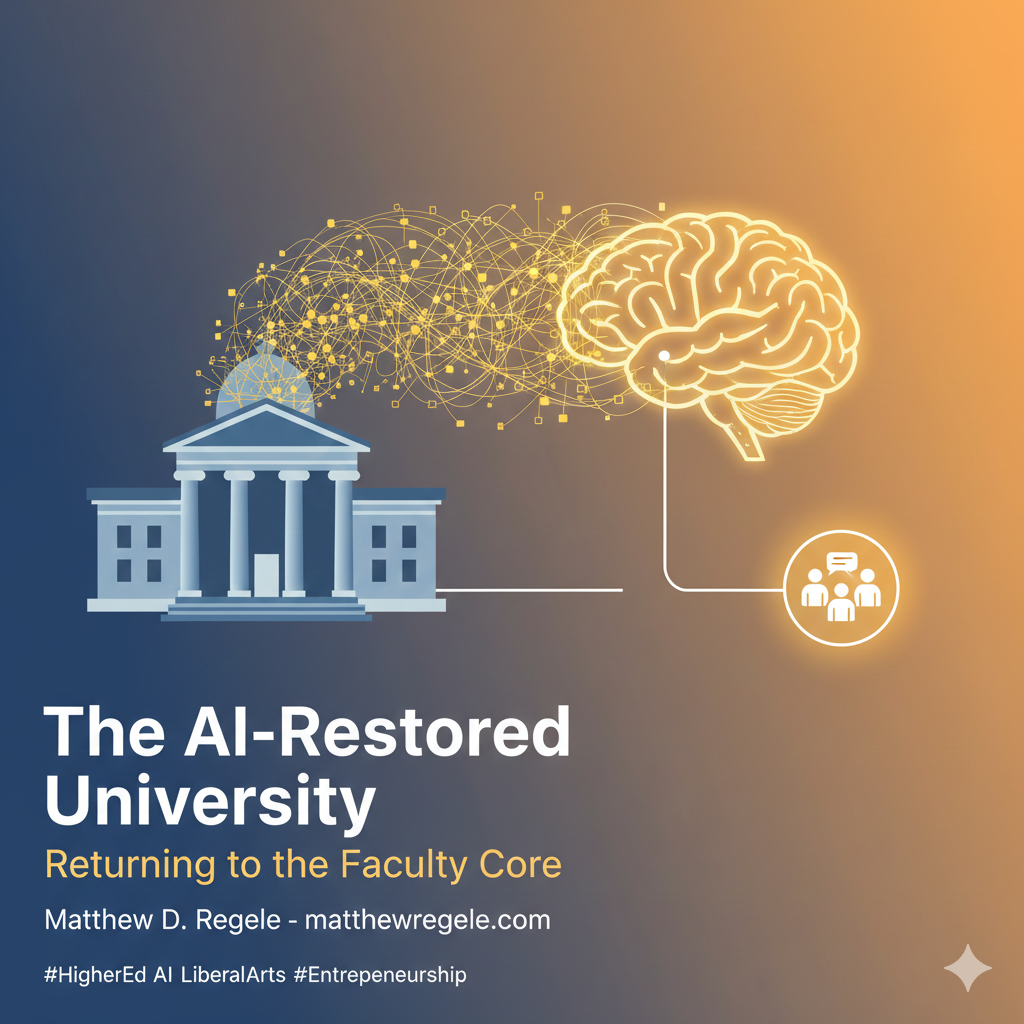
The AI-Restored University: Returning to the Faculty Core
Introduction
For decades, American universities have drifted toward a model defined by administrative expansion. Much of it began with reasonable intentions: support services, compliance, accreditation, career placement, and the complex infrastructure of a modern institution. But the accumulated result is a system defined by layers and process, often at the expense of the sustained, high-quality teaching and mentoring that families believe they are paying for.
This drift takes us further away from the traditional promise of a liberal arts education: the development of an intellectual portability that allows a student to navigate unfamiliar contexts with judgment and agency. It is a promise to help students feel “at home in all lands and all ages”—to carry the keys of the world’s library in their pocket and to cooperate with others for common ends.1
Agentic AI presents a once-in-a-generation opportunity to return to this kind of core mission. Its deeper potential is to automate a large share of the university’s administrative machinery, making it possible to redirect money and time back to the faculty-student relationship, where the core educational value is actually created.
A moment of candor
I don’t think AI automates everything today. But I can see what’s coming.
I recently felt it while working on a major course revision. An instructional designer mentioned that her team already has access to AI-powered design tools integrated into our LMS. In a moment of candor, she “joked” that the AI might replace her in a few years.
I don’t think it was a joke. If a tool can generate module structures, draft rubrics, and iterate rapidly based on feedback, then a meaningful chunk of the work that currently requires specialized staff becomes easier to scale. This forces a question: When the managerial layer becomes automated, what is the university’s true value-add?
The wrong focal point: “AI will disrupt the classroom”
Most public conversation about AI in higher ed fixates on the classroom: cheating, detection tools, and new pedagogy. Those debates matter, but they’re strategically too small.
Universities are giant coordination systems. Coordination—routing requests, tracking compliance, and making bureaucratic processes legible—is exactly what agentic AI is good at. The bigger question isn’t “How will AI change teaching?” It’s: How much of the university’s bureaucracy exists primarily because humans have been the only affordable way to run it?
Two futures
As AI capabilities improve, universities face a fork in the road:
Future A: AI accelerates the existing bureaucracy. The machine becomes more efficient, but it stays the machine—more dashboards and more required documentation.
Future B: AI compresses the bureaucracy—and we reinvest in the core. Automation makes it possible to run the institution with fewer layers, redirecting resources toward what students cannot download: real mentorship and intellectual community.
What becomes scarce in an AI-rich world
In an AI-rich world, information and drafts become commodities. What becomes scarce are uniquely human qualities: judgment, taste, moral courage, and the ability to cooperate under real stakes.
Interestingly, this isn’t just a plea for nostalgia; it is a forecast from the architects of the technology itself. Anthropic President Daniela Amodei recently argued that a background in the liberal arts will be “more important than ever” because AI is already so proficient at STEM. As technical outputs become automated, the human ability to empathize and navigate social friction becomes the high-value currency.
This is the essence of being “at home in all lands.” It describes an intellectual portability that an algorithm cannot replicate. This portability is what the liberal arts—and fields like entrepreneurship and management—strive to develop. AI can process data from any “land” or “age,” but it cannot inhabit them or bear the consequences of the choices made within them.
What “AI-restored” could look like
If we use AI for compression rather than expansion, we could see:
- Fewer transactions: AI agents triage requests, reducing the administrative “email spiral.”
- Compliance as a byproduct: AI converts operational data into reports, ending “assessment theater.”
- Responsive Advising: Logistics are automated, freeing human advisors for high-judgment conversations about identity and purpose.
- Reinvestment: Saved overhead funds smaller seminars, undergraduate research, and intensive mentoring.
Next steps
This is an early-stage provocation, but it is one I intend to explore through my work as an educator and researcher. We should not be asking only how AI will “disrupt” the classroom. We should be asking how AI can make the rest of the university’s bureaucracy obsolete so we can afford a genuinely human education again.
The AI-restored university is not a world without support or care. It’s a university that finally stops confusing complexity with quality and re-centers itself around the work that cannot be automated: human formation through sustained, in-person learning.
Footnotes
Footnotes
-
A nod to my alma mater, Bowdoin College, which articulates this mission so eloquently in “The Offer of the College.” It’s a vision for higher education that has stayed with me ever since I first arrived on campus. ↩