Misimagining Higher Education
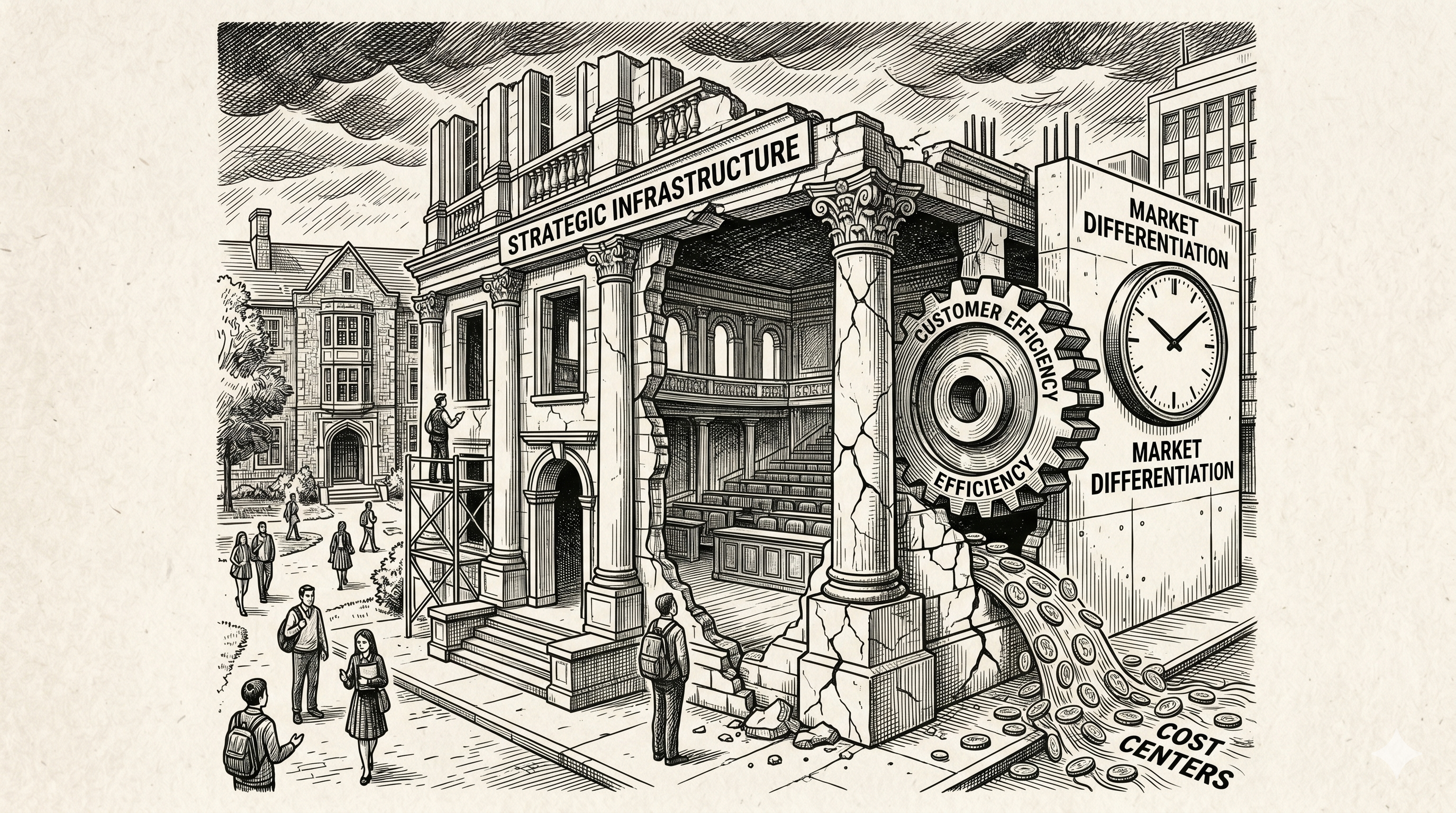
Misimagining Higher Education
America is not just underfunding higher education. It is misimagining it.
That matters because, for all their flaws, colleges and universities have been one of the country’s great institutional strengths. They have produced research, attracted talent, trained professionals, and expanded national capacity in ways that are hard to rebuild once weakened. In FY 2024, U.S. colleges and universities spent $117.7 billion on research and development. International students contributed $42.9 billion to the U.S. economy and supported 355,736 jobs in the 2024–25 academic year.
Part of the problem is obvious. Universities face political attacks, threats to research funding, hostility to expertise, and policies that make it easier to treat higher education as an ideological target than as strategic infrastructure. But the deeper problem is quieter. Even when we are not attacking universities outright, we are narrowing our understanding of what they are for.
A lot of current rhetoric treats colleges and universities mainly as job-training centers serving customers. If students are paying high tuition, the reasoning goes, then the institution’s job is to deliver a marketable credential and a clear labor-market payoff. That concern is not irrational. Tuition is high, and students and families are right to care about work, debt, and value.
The mistake is not in caring about careers. The mistake is in allowing that concern to shrink the university’s mission into something far narrower than the institution that helped make the United States unusually strong.
W. Norton Grubb and Marvin Lazerson saw this problem clearly. In their work on the “education gospel,” they argue that Americans have repeatedly loaded schooling with the expectation that it should solve economic and social problems chiefly by preparing people for work. Their concern was not that employment is unimportant. It was that vocationalism can crowd out a fuller understanding of what education is for.
That critique feels even more relevant now. Once universities are understood primarily as labor-market suppliers, almost everything else they do becomes harder to justify.
And yet that “everything else” is a large part of what made American higher education such a strength in the first place. Universities did not become a national advantage because they functioned only as workforce pipelines. They became an advantage because they did several things at once. They prepared students for work, produced research, trained scientists and professionals, attracted ambitious people from around the world, and sustained forms of intellectual development that were never fully reducible to first-job placement.
Seen this way, the current narrowing is not just conceptually mistaken. It is strategically foolish. Other countries are trying to build world-class universities and research capacity. The United States already has much of that infrastructure, but often seems oddly willing to damage it through short-term politics, underinvestment, and a reductive public vocabulary that treats universities mainly as cost centers, ideological enemies, or overpriced credential vendors.
To be fair, universities themselves helped invite some of this narrowing. Many institutions have leaned hard into the language of employability, return on investment, customer satisfaction, retention management, and market differentiation. They have sometimes marketed themselves less as places of learning and inquiry than as managed pathways to personal advancement. And in some cases, they have also struggled to defend the academic rigor that makes higher education worth defending in the first place. Richard Arum and Josipa Roksa’s Academically Adrift became famous because it argued that many students were making limited learning gains under conditions of low academic demand. The book’s conclusions were debated, but the larger warning still matters. When colleges make it too easy to see themselves as costly credentialing operations with too little intellectual challenge, they should not be surprised when the public starts asking narrower and more transactional questions about value.
Consider how the syllabus is treated today. In fields like management and strategy, a syllabus is increasingly viewed not as an invitation to explore complex problems but as a service agreement. Students often arrive expecting plug-and-play templates, like the five steps to a perfect pitch deck or a standardized framework for market entry. When asked to step back and critically examine the structural flaws of a market or the ethical implications of a business model, the transactional mindset kicks in. The demand for immediate and friction-free relevance strips out the deep, critical inquiry that makes the education valuable in the first place.
Still, the answer to high tuition and public frustration cannot be to hollow higher education out until little remains beyond narrower training and more transactional relationships with students. That would leave students paying a great deal for something smaller, weaker, and less durable than a real education.
The problem is not that students want value. It is that, in responding to that pressure, we risk defining value far too narrowly. Once that happens, rigor starts to look like bad customer service, intellectual breadth like inefficiency, and research without an immediate payoff like indulgence. Over time, the cumulative effect is to weaken the very features that made higher education valuable in the first place, including depth, breadth, rigor, discovery, and some insulation from the narrowest short-term market demands.
None of this means every program is equally viable, every research agenda equally fundable, or every academic aspiration insulated from tradeoffs. Universities still have to make choices. Resources are finite. The question is what those choices are made in service of. Is it a rich and demanding vision of education and knowledge, or a shrinking model that treats universities mainly as customer-serving workforce vendors?
What universities should offer students is not a guaranteed job and not a watered-down education designed to minimize friction. It should be the strongest education the institution can provide. That means one that helps prepare them for work, certainly, but also develops judgment, broadens understanding, and connects them to forms of knowledge that outlast the first hiring cycle.
A country, likewise, should want more from its universities than narrow workforce sorting. It should want institutions capable of producing knowledge, cultivating talent, and strengthening the common good.
That is why I keep coming back to the same conclusion. The United States is not just underinvesting in higher education. It is shrinking its idea of what higher education is for.
And that is how countries squander strengths they spent generations building.