When Universities Measure Ownership Instead of Education
When Universities Measure Ownership Instead of Education
A new academic program launches with five students. A year later, it has fifteen.
That gets reported as 200 percent growth.
At the same time, another department teaches hundreds of students across the university. It runs large introductory courses, supports multiple majors, contributes to general education, and gives students skills they use in many other fields. Its number of primary majors is flat or slightly down.
That gets reported as stagnation.
These are not just different enrollment stories. They reflect a deeper problem in how universities decide what counts.
Most universities need some way to connect student activity to departments. That is reasonable. Faculty lines, budgets, course schedules, and program decisions must be grounded in something. A department with no students cannot be sustained indefinitely on the argument that its work is important in the abstract.
But the “something” universities count is often narrower than the educational value they claim to care about.
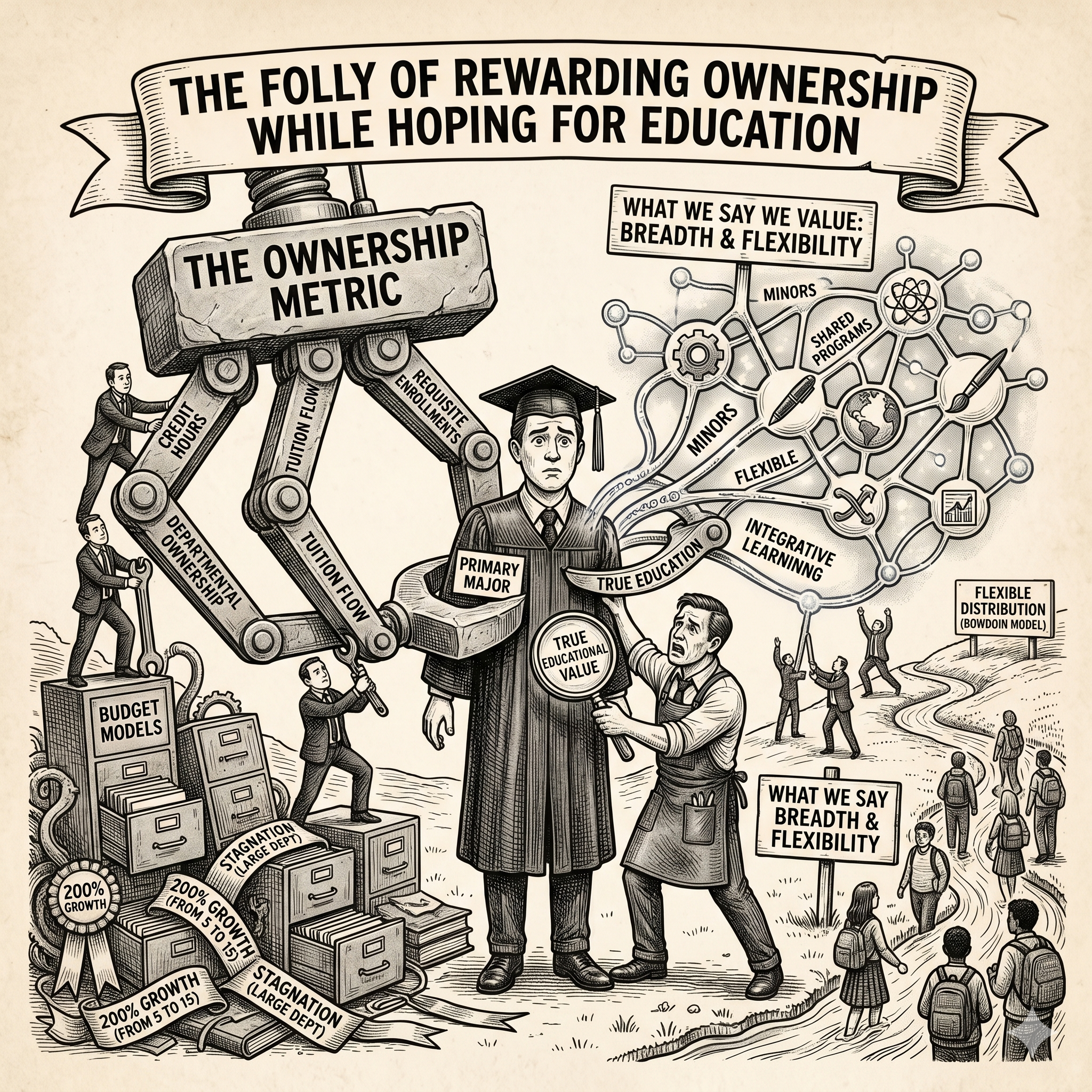
Under Responsibility Center Management and similar decentralized budget models, student activity often becomes a key input into resource allocation. The exact formula varies by institution, and many universities use hybrid models, but these systems commonly tie resources to measurable activity such as credit hours, enrollments, tuition flows, and other indicators of unit performance. Budget models do not merely track resources. They also shape incentives and reveal institutional priorities.
In practice, departments usually get the most visible credit for primary majors. Sometimes they also get credit for course enrollments. But they often receive little or no recognition for minors, second majors, co-majors, or the many students they teach who never formally belong to the program.
That leads to a simple but important shift.
Universities do not just measure student demand. They measure departmental ownership.
The Ownership Metric
Once ownership becomes the unit of value, behavior follows.
Departments invest heavily in converting students into primary majors. New majors and certificates proliferate. Programs that are designed to complement other fields become harder to justify. A department that teaches many students across the university can look weak if relatively few of those students are counted as its own.
Entrepreneurship is a useful example, and I should acknowledge that it is also my field. That makes me less than neutral, but it also makes the issue easy for me to see.
For many students, entrepreneurship may be most valuable as a minor, second major, or co-major. It often works best when layered on top of another discipline. A finance student, an engineer, an artist, a health sciences student, or a marketing major can all benefit from entrepreneurship training that helps them apply their skills in uncertain, real-world settings. This view is consistent with the Kauffman Foundation’s long-running argument that entrepreneurship education should not be confined to a single professional silo, but should become a broader part of undergraduate education.
But in a system that mainly counts primary majors, that structure can look weak. A program that reaches across the university can appear small because it does not “own” its students.
The structure that may work best educationally is not always the structure that gets rewarded administratively.
This is not unique to entrepreneurship. Similar problems can arise in writing, data analytics, sustainability, leadership, ethics, and other cross-cutting areas. These fields often create value by helping students connect, apply, and extend what they are learning elsewhere. AAC&U’s Integrative and Applied Learning VALUE Rubric emphasizes students’ ability to make connections across ideas, experiences, courses, and contexts. That kind of educational value is easy to miss when the main question is how many students belong to one department.
Rewarding A, While Hoping for B
Steven Kerr described this kind of problem in his classic article, “On the Folly of Rewarding A, While Hoping for B”. Organizations often say they want one thing while building reward systems around something else. Kerr’s broader point is that people respond to the behaviors that are actually rewarded, not the values leaders say they care about.
Higher education often has a version of this problem.
Universities say they value breadth, interdisciplinarity, student exploration, and flexible pathways. But internally, they often reward primary majors, required enrollments, and departmental control over student flow.
The behavior that follows is not irrational. Departments are responding sensibly to the incentives in front of them. The problem is that the incentives do not fully match the educational values institutions claim to hold.
The Core Curriculum Land Grab
This same logic also helps explain some of the politics around general education and core curricula.
If majors are one way to secure students, required courses are another. When departments cannot “own” students through majors, they can still ensure a steady flow of enrollments by getting courses into the core.
That creates a second, parallel dynamic.
Departments push to have their courses included as requirements. Once included, those courses generate predictable enrollment regardless of whether students would have chosen them freely. Those enrollments support faculty lines, stabilize scheduling, and signal relevance.
Over time, the question can shift.
Instead of asking, “What should an educated student experience?” institutions may start asking, “Which departments should have guaranteed access to students?”
To be clear, the idea of a core is not the problem. Most people would agree that students should encounter different ways of thinking. They should write, reason quantitatively, engage with science, understand society, encounter the arts, and wrestle with questions of difference, power, history, and culture.
Breadth matters.
The issue is how breadth gets translated into requirements.
Some requirements are clearly defensible. But requirements are not only educational statements. They are also organizational arrangements. They determine where students must go, which departments receive enrollments, and which forms of knowledge are formally recognized as part of the institution’s definition of an educated person.
That means even broad requirements create winners and losers.
As Patricia Dwyer noted in an AAC&U essay on revising core curricula, changes to credit hours and course requirements quickly bring politics and turf battles into play. Her essay, “Transforming a Core Curriculum—and Minimizing the Battle Scars”, is a useful reminder that general education reform is never just a technical exercise.
The Bowdoin Contrast
Bowdoin College offers a useful contrast, though not a perfect one. Bowdoin does not have a heavy common core built around a long list of specific required courses. Its current curriculum uses a first-year writing seminar, five broad distribution areas, and three divisions of the curriculum. The distribution areas include mathematical, computational, or statistical reasoning; inquiry in the natural sciences; difference, power, and inequity; international perspectives; and visual and performing arts.
That structure still involves choices. Someone had to decide which categories count. In fact, Bowdoin’s requirements have changed since I was a student there. I remember the distribution requirements being organized differently, and I do not remember visual and performing arts standing as its own separate category. My point is not that the older version was better or that the newer version is worse. It is that these categories do not appear by themselves. They are chosen, debated, and negotiated. The current inclusion of visual and performing arts as a distinct distribution area is not just a technical adjustment. It reflects a judgment that artistic expression, performance, and interpretation should be part of a liberal education.
So Bowdoin is not an example of a curriculum without politics. No curriculum is.
But it does show that requirements can be designed with more or less constraint. Broad categories give students more room to satisfy institutional goals through courses that fit their interests and major pathways. They can preserve breadth without forcing every student through the same narrow set of departmental gates.
Bowdoin is, of course, an unusual case. It is a small, highly selective liberal arts college. Its on-campus FTE enrollment in fall 2025 was 1,838, and its endowment reached roughly $2.9 billion at the end of fiscal year 2025, according to Bowdoin’s institutional data. Most colleges and universities operate under very different constraints. They have more professional programs, more transfer students, more complicated accreditation demands, and far fewer resources per student. So Bowdoin should not be treated as a simple model to copy.
But that is also why the example is useful. Bowdoin’s curriculum fits its strategy. The college has chosen to remain small, selective, residential, and centered on undergraduate liberal arts education. It almost certainly could have pursued another path by leveraging its reputation for growth, new programs, or broader market reach. Whether or not that path was ever formally on the table, it was available in principle. Instead, Bowdoin’s model reflects a coherent choice about what kind of institution it wants to be.
In that context, flexible distribution requirements are not incidental. They are part of the educational model. Bowdoin has maintained a strong reputation for undergraduate education while relying on relatively broad requirements rather than a highly prescriptive core. That does not prove every institution should copy Bowdoin. It does show that breadth and flexibility are not opposites.
Measuring What Matters
This brings us back to the larger issue.
Universities need ways to allocate resources based on student activity. Majors matter. Enrollments matter. Departments need students, and programs without student demand should not be immune from scrutiny.
But when student activity is measured too narrowly, departments adapt in predictable ways. They try to own students through majors, or they try to secure access to students through requirements.
Over time, those incentives shape the curriculum itself.
Programs become more siloed. Requirements become more crowded. Minors, second majors, co-majors, and shared programs receive less recognition than they deserve. Courses that serve students across the university can be treated as secondary because they do not produce enough departmental ownership.
Students experience the consequences directly.
Required courses can be valuable. But each added requirement also claims space in a student’s schedule. As requirements accumulate, it becomes harder to combine interests across fields. Exploration gives way to checking boxes. A student who wants to pair biology with entrepreneurship, computer science with ethics, or political science with data analytics may find that the structure of the curriculum leaves less room than the rhetoric of interdisciplinarity suggests.
The system is not trying to limit students.
But it often does.
That is the problem with measuring ownership instead of education. It makes certain forms of value visible and pushes others into the background. It rewards departments for capturing students, even when the institution says it wants students to build flexible and meaningful pathways across fields.
So, how should we count it instead?
Finding ways to legitimately reward cross-disciplinary teaching, matrixed credit hours, or shared student pathways is undeniably difficult. It requires untangling decades of entrenched budget models and rethinking how we allocate faculty lines.
But some of the most valuable parts of a university are designed to be shared. If we actually want to build the institutions we claim to be, places of exploration, breadth, and connection, we have to start measuring the education students actually receive rather than the boundaries departments enforce.
Until then, the way universities measure success will continue to reward what can be owned.